 EN
EN ES
ES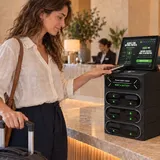
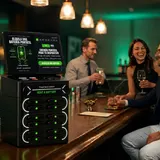

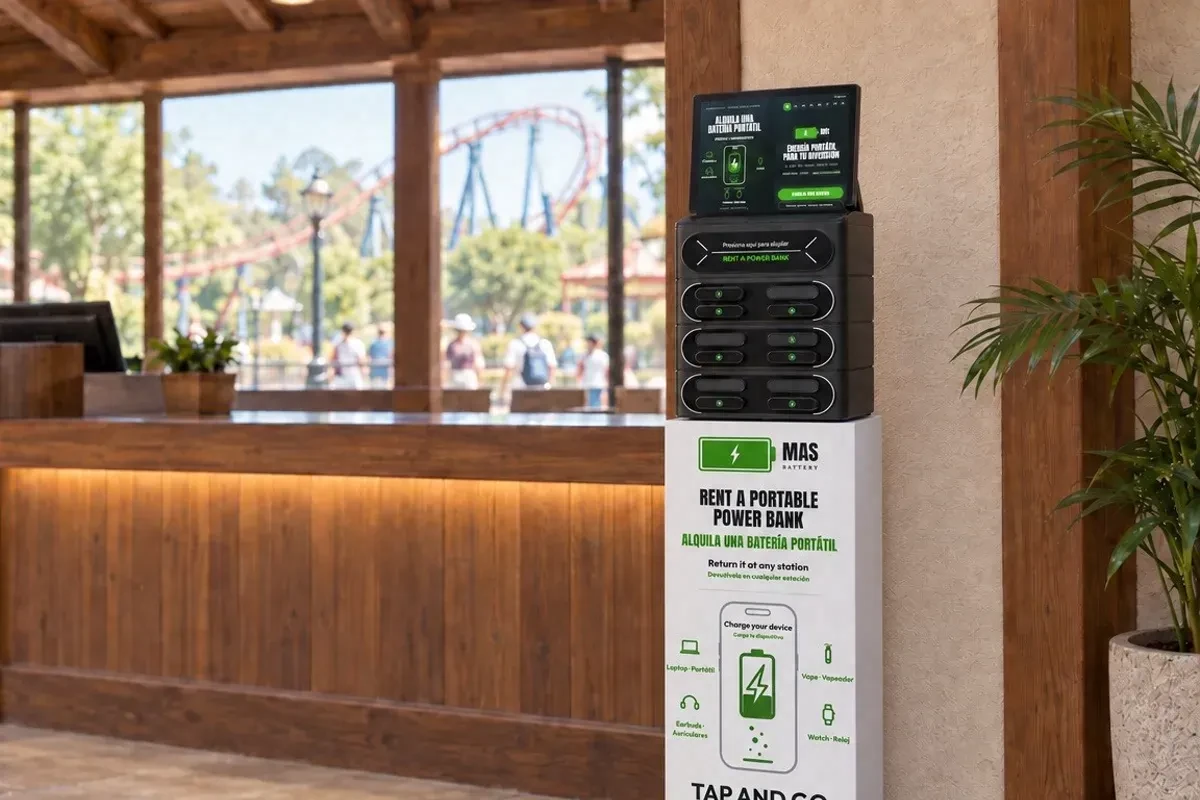
Shared power banks are a safe service for a venue when the stations and power banks are certified, installed in the right place and looked after. Before choosing a power bank rental service, a venue should check seven things: CE marking, UN38.3 transport certification, RII-AEE registration in Spain, indoor or covered installation, cable condition, liability insurance and remote monitoring of the stations.
In short
- Ask for the CE declaration of conformity, the UN38.3 certification and the RII-AEE registration in Spain.
- Stations belong indoors or under cover, on a permanent power connection. The power bank is what travels with the guest.
- Ask how cable condition is checked and how a worn power bank leaves circulation.
- Check liability cover and whether the stations are monitored remotely.
What certifications should a shared power bank have?
Three documents cover what operations, legal and insurance teams usually ask for:
- CE marking and declaration of conformity. The manufacturer declares that the product meets the EU requirements that apply to it. Ask for the declaration, not only the logo on the label.
- UN38.3. The test standard lithium batteries must pass before they can be transported. It tells you the battery was tested for the conditions of shipping.
- RII-AEE registration. In Spain, electrical and electronic equipment placed on the market is registered with the RII-AEE register, which links the product to the producer responsible for it at end of life.
MasBattery stations and power banks are CE marked, meet the UN38.3 transport standard and are registered with Spain's RII-AEE electronics register. A full compliance file is available for your operations and legal team on request.
Where should phone charging stations be installed?
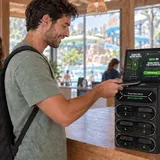
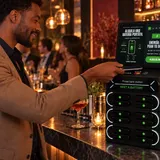
Indoors or under cover, with a permanent power connection and clear visibility for guests. That is how MasBattery stations are designed to be installed: at reception, in a lobby, on a bar counter, in a guest services building, under the existing covered structures of an event site. Your team chooses the spots with us before installation.
The station stays in one protected place. The power bank, a portable charger, is the part that travels with the guest, in a bag or a pocket, while the phone charges. A venue should check that each spot has a proper outlet, does not block an exit or a walkway, and is somewhere staff pass regularly.
Why does cable condition matter?
Built-in cables are what the guest handles most. A MasBattery power bank has exactly two built-in cables, USB-C and Lightning for iPhone, so guests do not plug in cables of unknown origin. Cables still wear with use, so ask any operator:
- how often power banks and cables are checked;
- what happens to a power bank with a damaged cable or one that no longer holds a charge;
- how a guest reports a problem.
With MasBattery, a guest whose power bank does not charge the phone can return it at any station, rent another and tell us through Help on the station screen or on WhatsApp, so we can put it right.
What should a venue check about insurance?
Ask the operator for proof of liability cover and tell your own insurer about the installation. Liability coverage per station is part of the documentation MasBattery shares with festival and venue operations teams. Your insurer may also ask for the CE, UN38.3 and RII-AEE documents, so keep them on file with the rest of your equipment records.
How does remote monitoring help?
A monitored station reports its status without anyone on your team checking it. MasBattery stations are monitored remotely, so a station that goes offline or develops a fault can be seen and handled, with maintenance and technical support set out in your proposal. Support runs on WhatsApp in Spanish and English.
Is the payment side safe for guests?
Guests pay with a contactless card, Apple Pay or Google Pay on the station's reader. There is no app to install, no account to create and no code to scan, so guests do not create an account or type in personal details to rent. Your staff never handle guest cards, phones or payments.
When the guest taps, a temporary hold is placed on the card, not a charge. On return, only the rental time is charged and the rest of the hold is released. If a guest pays and no power bank comes out, the order is cancelled and refunded automatically. Guests can read how it works on charges, holds and returns.
Is a shared power bank safe for the guest's phone?
The power bank charges the phone through its own built-in cables, with fast charging at up to 20 W through either cable. Each power bank gives up to 1.5 charges, depending on the phone. The guest keeps the phone in hand the whole time, which is one of the differences with a charging locker. We compare both in charging lockers vs power bank rental stations.
What should a venue ask before signing?
- Can we see the CE declaration of conformity and the UN38.3 certification?
- Is the equipment registered with RII-AEE in Spain, and under which producer?
- Where will each station go, and what power connection does it need?
- How are cables and power banks checked, and how is a worn one taken out of use?
- Which liability cover applies, and can we have a copy?
- Are the stations monitored remotely, and who responds to a fault?
- How do guests reach support, and in which languages?
A good operator answers each one in writing. If you are also weighing up buying the hardware yourself, buy charging hardware or work with an operator lists the work that comes with it.
Next step
Tell us about your venue. We reply within one working day, and the compliance documents are available for your operations team on request. See how it works for hotels, theme parks, bars and clubs, casinos and festivals, or request a proposal.