 EN
EN ES
ES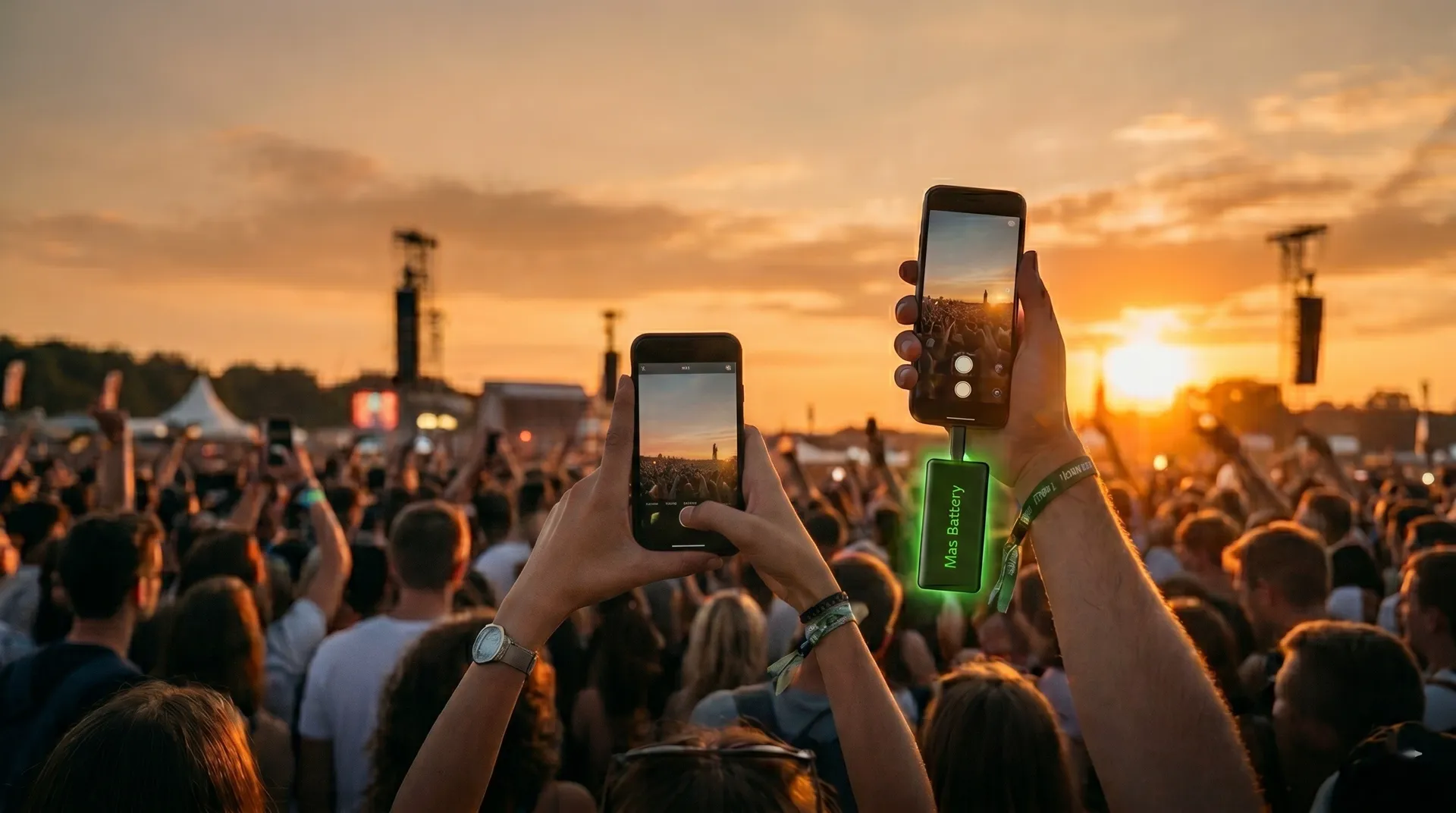
To offer phone charging at a festival or event in Spain, an organizer needs to plan five things: where the charging points go, what power and cover they need, how attendees pay, who handles support and lost batteries, and which documents the operations team will ask for. A power bank rental service covers all five with self-service stations: attendees tap a card, take a charged power bank and keep moving, and the organizer shares in the rental revenue.
In short
- Attendees are on their feet all day, far from a socket, so charging has to come to where the crowd gathers.
- Stations go under existing covered structures such as entrances, stage wings and food courts, with a placement plan agreed before the event.
- Attendees pay with a contactless card, Apple Pay or Google Pay. No app, no registration.
- The organizer provides a small footprint and power access. Scope, pricing structure and revenue share are defined in each proposal.
Why does a festival need its own phone charging?
When an attendee's battery dies, their festival changes. They stop spending, lose their friends and leave early. Without a phone they cannot use a digital wallet or the festival app, they stop posting the stories and videos that market next year's edition, and they cannot receive emergency broadcasts or contact medical staff when needed.
Your attendees are on their feet all day, far from a socket. Charging that only works next to a wall does not reach them.
What are the options for charging at an event?
Festivals have usually solved this in one of three ways:
- A cable tent. Attendees plug in and wait next to the tent while the phone charges.
- Charging lockers. Attendees leave the phone in a locked compartment and come back for it later.
- Power bank rental stations. Attendees take a charged power bank and keep the phone with them, then return the power bank at any station on site.
The first two keep the attendee, or their phone, in one place. Carry-and-return power banks let them go back to the stages, the bars and their friends while the phone charges. There is a longer comparison in charging lockers vs power bank rental stations.
Where should phone charging stations go at a festival?
Where the crowd gathers: entrances, near the main stages and around food courts, in visible spots attendees will not miss. Stations sit under existing covered structures so they stay out of direct weather.
Placement is something to work through in detail with your production team during the pre-event walkthrough. The plan is agreed together before deployment, with the site map and the conditions your team knows best in mind. Spreading stations across the site matters, because any power bank can be returned to any station on site: attendees pick up near where they are and return near where they end up.
What does the organizer need to provide?
A small footprint for each station and power access. Hardware, delivery, installation and on-site support are set out in your proposal, including the stations, power banks, cables and on-site equipment. You share in the rental revenue.
How do attendees pay, and what do they pay?
Attendees tap a contactless card, Apple Pay or Google Pay. A charged power bank ejects in seconds, with USB-C and iPhone cables built in. No download, no signup, no account: nothing standing between the attendee and a charge, and nothing slowing down the flow at the gates.
The right pricing structure depends on your audience and the length of the event:
- Hourly rental. Pay-as-you-go for casual events and shorter durations. Attendees pay only for the time they use.
- Day or festival pass. A flat fee with unlimited swaps. Predictable for attendees, easy on your guest-services team.
- Custom mix. Hybrid pricing, modelled around your audience.
Whatever the structure, the price is shown on the station screen before the attendee confirms.
What happens if an attendee loses a battery?
The attendee pays for it, and your team never has to worry about it. When an attendee takes a power bank, a temporary hold is placed on their card. If the power bank is not returned within the period shown on the station screen, the replacement cost shown there is charged.
Which documents will the operations and legal teams ask for?
The certifications that operations, legal and insurance teams actually need:
- CE Declaration of Conformity
- UN38.3 transport certification
- RII-AEE registration in Spain
- Liability coverage per station
A full compliance binder is available for your operations and legal team on request.
What does the timeline look like?
- Before gates open. Stations are delivered and connected before the event opens, followed by a quick walkthrough with your production team. Typical installs are completed in a single day on site.
- During the event. Support during the event helps keep charged power banks where the crowd is, including rebalancing stations, as agreed in your proposal. The on-site team works in Spanish and English, and WhatsApp support runs in both languages throughout the event.
- After the event. You receive a detailed report, and your revenue share is transferred after the event.
Can phone charging earn revenue for the event?
Yes. Charging becomes a revenue line rather than a cost line. You share in the rental revenue, and the LED screens on the stations can carry sponsor advertising. At your festival, the stations can carry your logo, so attendees see your name. How the work is shared and how the revenue is split are set out in each proposal.
How to start planning
Tell us about the event: the expected crowd, the layout of the site and the dates. We walk through placement, the pricing structure and your numbers together on a 20-minute call. MasBattery is based in Valencia, Spain.
See how it works for festival organizers, or book a call.