 EN
EN ES
ES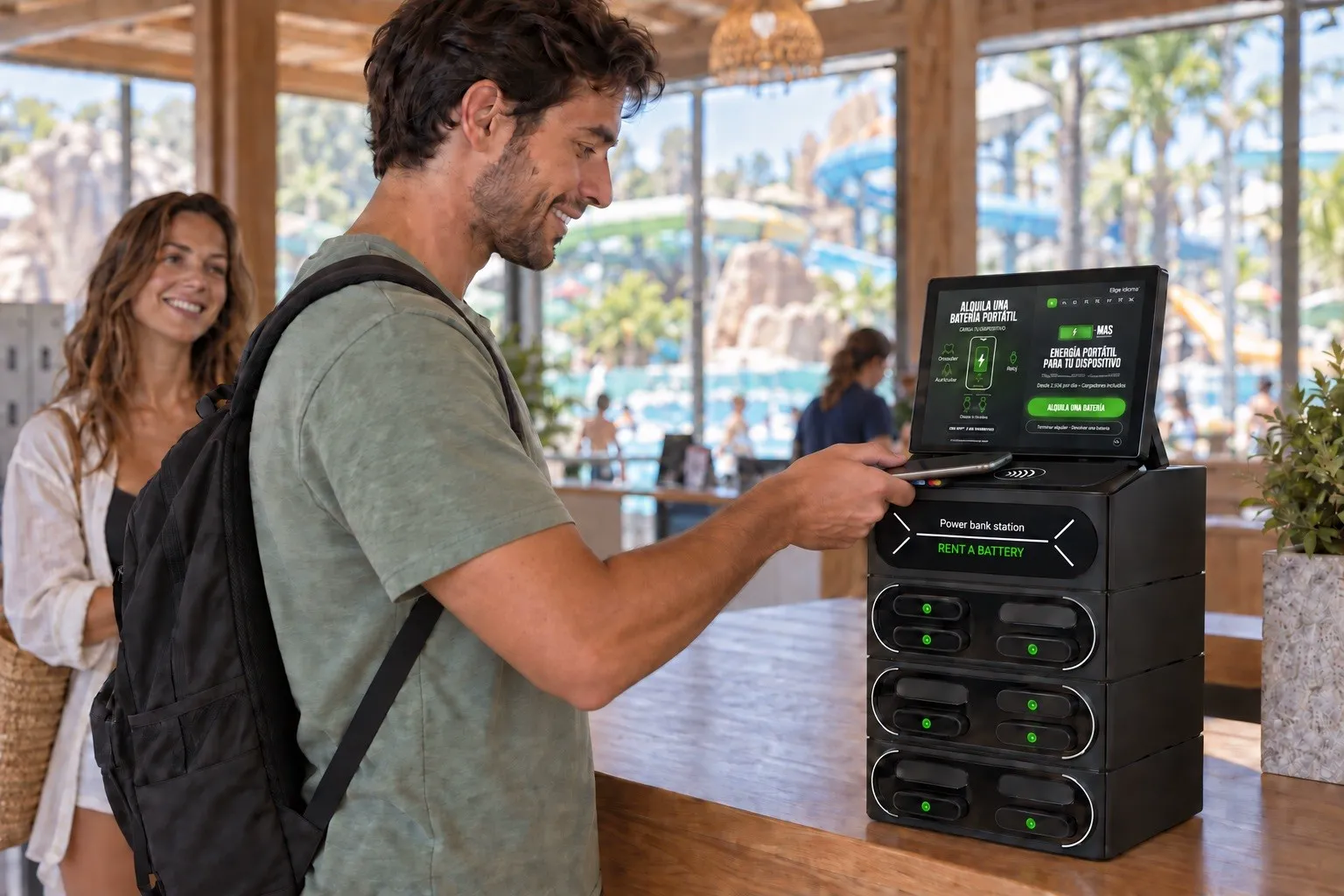
In a revenue-share power bank rental, an operator places power bank rental stations in your venue, your guests pay per rental at the station, and the venue receives a share of that rental revenue. At MasBattery, the venue provides the space and the power, and the split, the scope of the service and how the share is settled are defined in each proposal.
In short
- The venue provides visible spots and a power outlet. The operator provides the stations and power banks and helps with installation, maintenance and support.
- Guests pay at the station with a contactless card or phone wallet. The venue's staff do not handle payments.
- Revenue comes from rentals, and the station screens can also carry sponsor advertising.
- The split and the commercial setup are defined in each proposal, not in a public price list.
What does the venue provide?
A visible spot for guests and a power outlet at each station. Stations are installed indoors or under cover, with a permanent power connection, in places your team chooses: reception and lobbies in a hotel, the busiest points of a park, the entrance or the bar in a club, the areas where the crowd gathers at a festival. At a festival, that means a small footprint and power access.
What does the operator do?
MasBattery helps with delivery, installation, maintenance and technical support, with the exact scope set out in your proposal. Stations are monitored remotely, with 24/7 remote diagnostics. At events, on-site support helps keep charged power banks where the crowd is. Support runs on WhatsApp in Spanish and English.
Then there is the work guests never see: payment pre-authorisation, refunds and bank reconciliation, and compliance. How that work is shared is set out in each proposal. Stations and power banks are CE-certified, UN38.3-compliant for transport and registered with RII-AEE in Spain.
Where does the revenue come from?
There are two lines:
- Rentals. Guests pay for the time they use a power bank, and the venue shares in that rental revenue.
- Advertising. The station screens can display sponsor advertising, which is a second source of income.
Stations can also carry your own branding, so guests see your name.
How is the price for guests set?
The price depends on the venue and is always shown on the station screen before the guest confirms, together with the daily maximum and the hold. When the guest taps, a temporary hold is placed on the card, not a charge. On return, only the rental time is charged and the rest of the hold is released.
For events, the structure can be hourly rental, a day or festival pass, or a custom mix. The right one depends on your audience and the length of the event, and it is agreed with you.
How is the venue's share calculated and paid?
The split, what it applies to and how it is settled are defined in each proposal. There is no single public rate, because the right setup depends on the size of the venue, its opening hours and how guests use it. For a festival, you receive a detailed report and your revenue share is transferred after the event.
Does the venue pay anything?
The commercial setup, including installation, maintenance and support, is defined in each proposal, and venues share in the rental revenue. The exact structure depends on your audience and the length of your season or event, so we walk through the right setup and your numbers together on a 20-minute call.
Who carries the day-to-day risk?
- Lost or unreturned power banks. If a power bank is not returned within the period shown on the station screen, the replacement cost shown there is charged to the guest. Your team never has to chase it.
- Payment problems. If a guest pays and no power bank comes out, the order is cancelled and refunded automatically.
- Guest questions. Guests can use Help on the station screen, email or WhatsApp. Issues are handled with MasBattery support, as set out in your proposal.
- Staff time. Staff do not handle guest phones, cards or payments. Guests rent and return power banks themselves.
Why not buy the hardware and run it yourself?
You could. But the hardware is the easy part. The work is everything around it: Spanish import and compliance, payment pre-authorisation, refunds and bank reconciliation, bilingual support, deployment logistics, and keeping charged power banks where guests are. How the work is shared, and how the revenue is split, is set out in each proposal.
What should a venue ask before signing?
- What exactly is included in installation, maintenance and support?
- What does the share apply to, and how is it reported?
- How often is the share settled, and how?
- Who handles guest support, refunds and unreturned power banks?
- Where can stations go, and what do they need from the building?
- Can stations be added or moved later?
- Which certifications do the stations and power banks hold?
A good proposal answers every one of these in writing.
Which venues is it suited to?
It works best where guests stay for hours and move around, and where a wall socket is a long walk away: hotels and resorts, theme parks and water parks, bars and clubs, casinos and festivals. The more time guests spend on site, the more a carry-and-return power bank is worth to them and to you.
MasBattery has had stations at a water park and a theme park on the Costa Blanca since August 2026. To see what a revenue share would look like for your venue, request a proposal. We reply within one working day.